Vinyl became a way of separating mastering from medium.
The first serious vinyl experiment was heard. The later LP5, AT33EV and phono-stage chain is research. Keeping those statuses separate makes the progression more useful, because the later theory grows from a real listening reaction rather than replacing it.
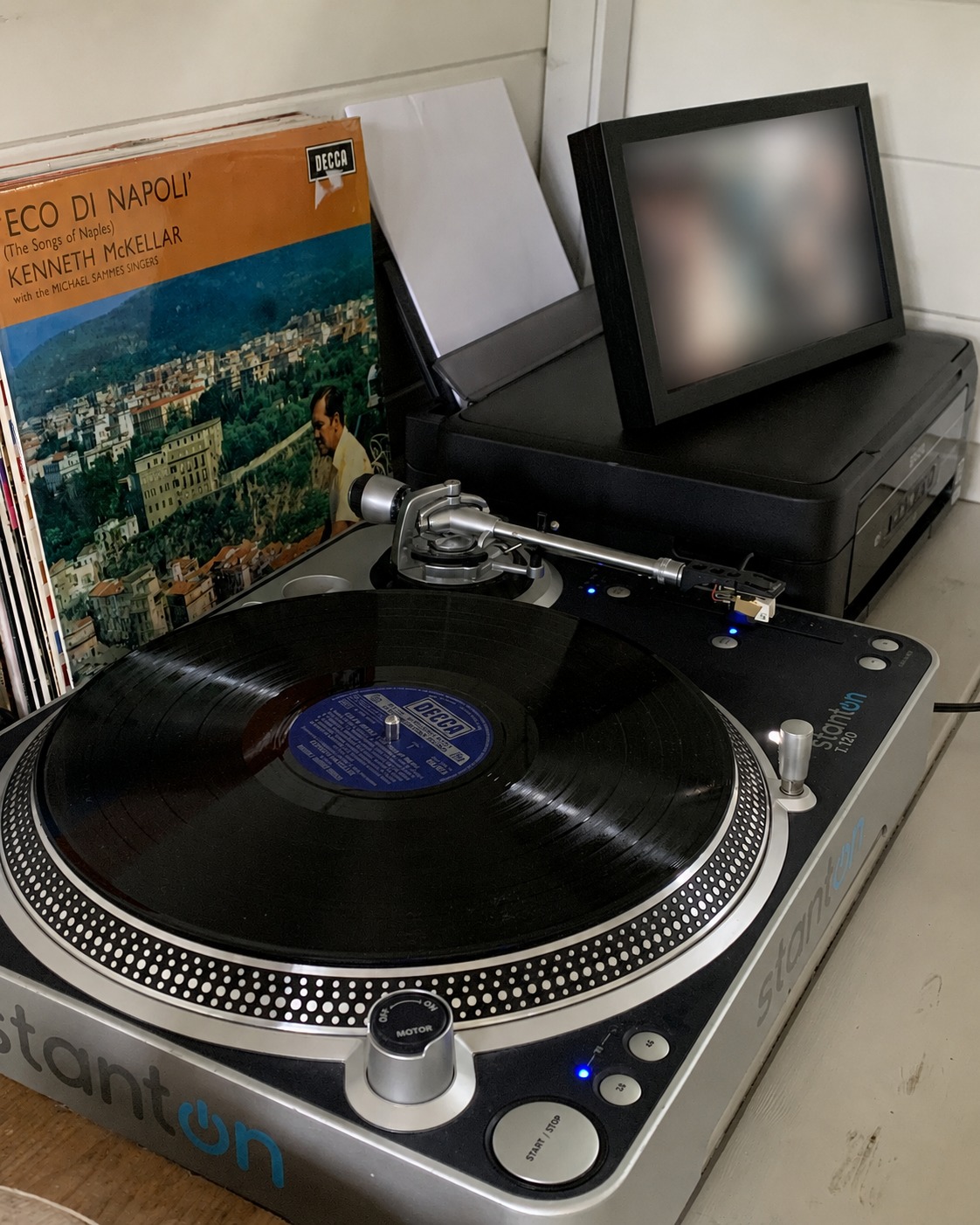
30 May 2023: listen to vinyl before designing the final vinyl system.
The borrowed Stanton T.120 was used to understand the feel of LP itself, not to crown a final turntable.
The notes describe older records as having scale, nuance and an inner warmth linked to analogue masters, with vinyl creating a particularly strong sense of being at the heart of the performance. At the same time, the tubed CD753 made it obvious that output stage and recording could create much of the same organic character.
The conclusion was already becoming format-agnostic: the recording and mastering can dominate, while the carrier and playback chain determine how much of that character survives.
Audio-Technica LP5 / LP5X + AT33EV.
The July 2025 “Vinyl Giant Killer” narrative develops a practical, modifiable turntable rather than assuming a prestige deck is the only route to a reference analogue front end.
LP5 / LP5X as the base, chosen for usability, sensible engineering and scope for later mechanical and cartridge development.
Internal damping, mat and isolation changes, bearing service and possible tonearm wiring improvements are explored as ways to reduce resonant and mechanical distraction.
AT33EV low-output moving coil becomes the preferred research direction for speed, tracking, coherence and a more ambitious analogue front end.
This full modified chain is a researched architecture. It should not be read as a completed personal comparison until it is actually assembled and heard.
The phono stage matters for the same reason the DAC output stage matters.
RIAA equalisation, gain, loading, noise, headroom and circuit character sit between a tiny cartridge signal and the rest of the system. The archive therefore treats the phono stage as part of the source, not a utility box.
Graham Slee Accession MC
A researched solid-state branch valued for control and accuracy rather than deliberate valve character.
Line Magnetic LP-33
A tube MM/MC route that fits the wider interest in dimensional analogue stages.
Black Ice F159
The later LP5/AT33EV narrative places the full-tube Fosgate design at the centre of an ambitious analogue chain.
“Giant killer” is a research challenge, not a completed claim.
The July 2025 master uses the Linn LP12 as a reference point for what a carefully developed LP5/AT33EV chain might challenge. The useful part is the architecture behind the claim, not the marketing phrase.
What the proposed LP5 route seeks
Mechanical control, moving-coil resolution, valve phono dimensionality, strong bass grip and the ability to archive a preferred pressing at high quality.
What an elite analogue front end still represents
Exceptional mechanical engineering, arm/cartridge optimisation, setup discipline and potentially a final increment of immediacy or ambient retrieval that is difficult for any replay chain to reproduce.
No public claim is made that the researched LP5 chain has personally outperformed an LP12. That comparison remains a hypothesis until the actual systems are heard.
If the record holds the best master, must every future listen remain mechanical?
The capture branch explores preserving that mastering and analogue front-end character, then replaying it through chosen digital architectures without pretending the digital copy can recreate information absent from the source.