One architecture. One listener at a time.
P17 is not a stocked production speaker. A pair is commissioned around the reference design, vintage driver availability, the destination room and a deliberately limited set of development choices.
Bespoke P17 loudspeaker commissions and custom HiFi speaker builds are available by discussion for clients in London, Hertfordshire and across the UK.
The starting point is defined.
The reference P17 uses a 20 cm SABA green-cone paper midrange, a 10 cm SABA green-cone paper high-frequency driver and a 15-inch McKenzie bass driver. A commission begins from that proven acoustic relationship before any bespoke development route is discussed.
Listening brief
Music, existing system, room, desired presentation and what you feel is missing.
Reference fit
Confirm that a large open-baffle/dipole loudspeaker makes sense for the space and intended placement.
Specification
Driver sourcing, cabinet finish, crossover baseline and any separately engineered options are fixed.
Build & voice
Assembly is followed by listening and verification before the pair is considered complete.
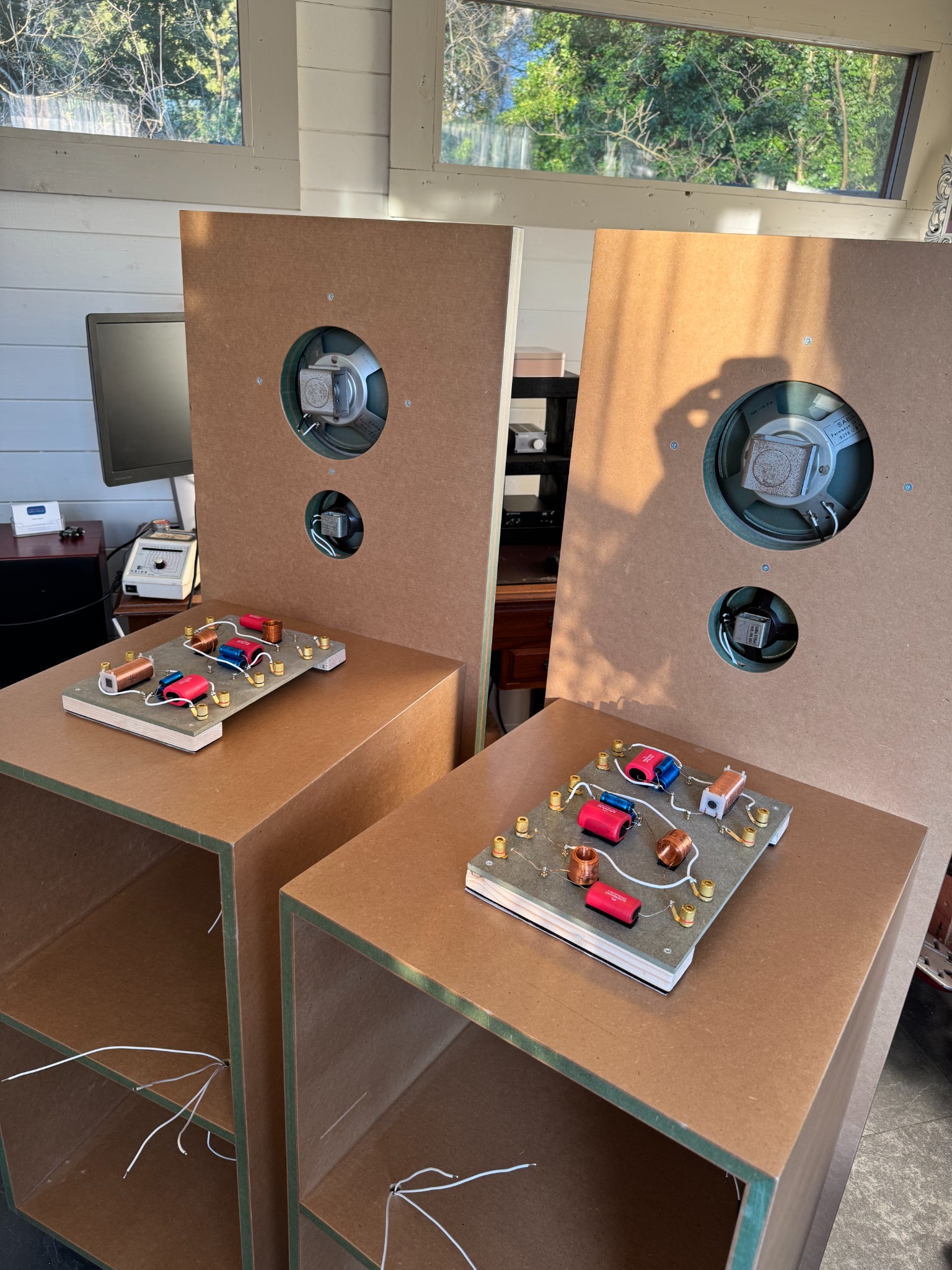
A reference concept, not a clone by parts list.
Vintage SABA availability means each build begins with careful sourcing. The purpose is to preserve the P17’s core voice, not to promise identical production tolerances from components that were never manufactured for a modern boutique loudspeaker line.
Where does the performance sit commercially?
Luke’s own listening estimate is that reproducing this combination of scale, immediacy, human presence and open spatial behaviour from contemporary commercial loudspeakers would push the comparison into roughly £20,000 territory.
This is a subjective benchmark based on personal listening experience. It is not a measured equivalence, independent valuation or claim that P17 will outperform every commercial loudspeaker at that price. The point is why commissioning can make sense: the design spends its complexity on unusual architecture and component choices rather than on distribution, dealer margin or mass-production constraints.
Before commissioning.
Is the current pair for sale?
No. The proposition is to commission a pair based on the reference architecture.
Does P17 need space behind it?
Yes. Open-baffle/dipole behaviour means the rear wave is part of the system, so the speaker benefits from breathing space and considered placement. Exact positioning depends on the room.
Can I specify a RAAL ribbon?
Potentially, but it would be a separately engineered variant rather than a driver swap. The crossover, level and integration would need to be designed around it.
Can the crossover use V-Cap ODAM/CuTF?
Potentially, but the later research is more nuanced than a full-V-Cap network. The mature studied route keeps ODAM/CuTF on the 10 cm high-frequency path, 80 µF ClarityCap CSA on the 20 cm midrange and 68 µF Monacor MKP on bass. A full-ODAM network remains an earlier cost-no-object exploration, while the original IPL/Alcap crossover remains the only built/heard reference.
Will every pair sound identical?
Vintage driver sourcing and room interaction make that an unrealistic promise. The objective is a consistent design philosophy and voicing target, with final choices documented.
How do I start?
Send a short description of your room, system, music and what you want the loudspeaker to do emotionally and spatially.
A commission can preserve the heard reference or deliberately explore one of three researched branches.
1. Reference network
4 µF IPL Supersound on the 10 cm high-frequency path; 70 µF Alcap + 10 µF IPL on the 20 cm midrange path; 60 µF Alcap + 8 µF IPL on the 15-inch bass path. This is the completed March 2025 musical reference.
2. Mundorf / Clarity route
The Lampizator-style premium hierarchy concentrated expenditure where the ear is most exposed: Mundorf Supreme for the high-frequency path, ClarityCap for the midrange, and a deliberately more pragmatic bass capacitor. This was an important bridge between the original network and the later V-Cap research.
3. Full V-Cap route
4 µF ODAM + 0.1 µF CuTF at high frequency, four 20 µF ODAMs for 80 µF midrange, and two 33 µF ODAMs selected towards roughly 68 µF for bass. This preserved the extreme cost-no-object branch, but it did not become the final researched recommendation.
4. Optimised allocation
4 µF ODAM + 0.1 µF CuTF on the 10 cm SABA, 80 µF ClarityCap CSA on the 20 cm SABA, and 68 µF Monacor MKP on bass. Later 2025 system documents carry this combination forward as the preferred researched architecture: exotic where influence is greatest, excellent film where scale matters, and no needless boutique spend in bass.
Reference-first remains the rule. The later ODAM/CuTF → ClarityCap CSA → Monacor MKP architecture is the preferred researched route, but it is still a development configuration until built and listened to in a complete pair.