Why this architecture?
The P17 is best understood as a set of linked decisions. Large dipole bass, open radiation, lightweight paper drivers, crossover voicing and room placement all contribute to the same listening goal.
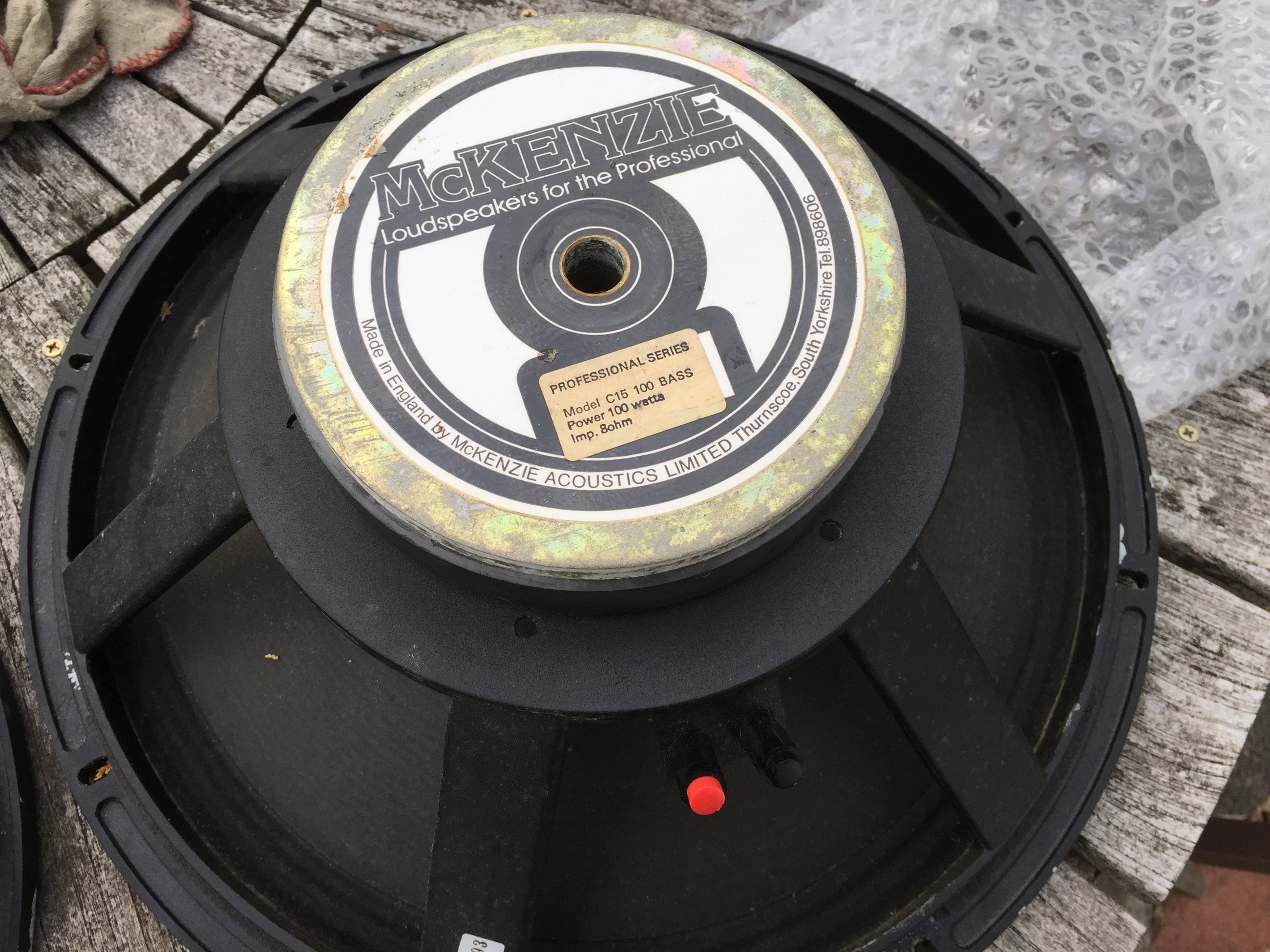
Scale without a conventional pressure box.
The 15-inch McKenzie does not work into a sealed or reflex chamber in the normal sense. Its rear radiation has an acoustic path back into the room, so front and rear waves form a dipole relationship.
That changes the problem. A dipole does not use trapped cabinet pressure or a port resonance to create bass. Its low-frequency output is shaped by driver area, excursion, baffle/path geometry, cancellation between front and rear radiation, placement and the room itself.
The large 15-inch cone is therefore not simply about “more bass”. Cone area helps the system move air with less sense of strain, while the open architecture can avoid some of the stored-energy character associated with conventional bass enclosures.
Important
No unmeasured frequency-response or sensitivity claim is made here. Dipole bass is placement-dependent. A commission must give the speaker breathing space and be considered with the actual room.
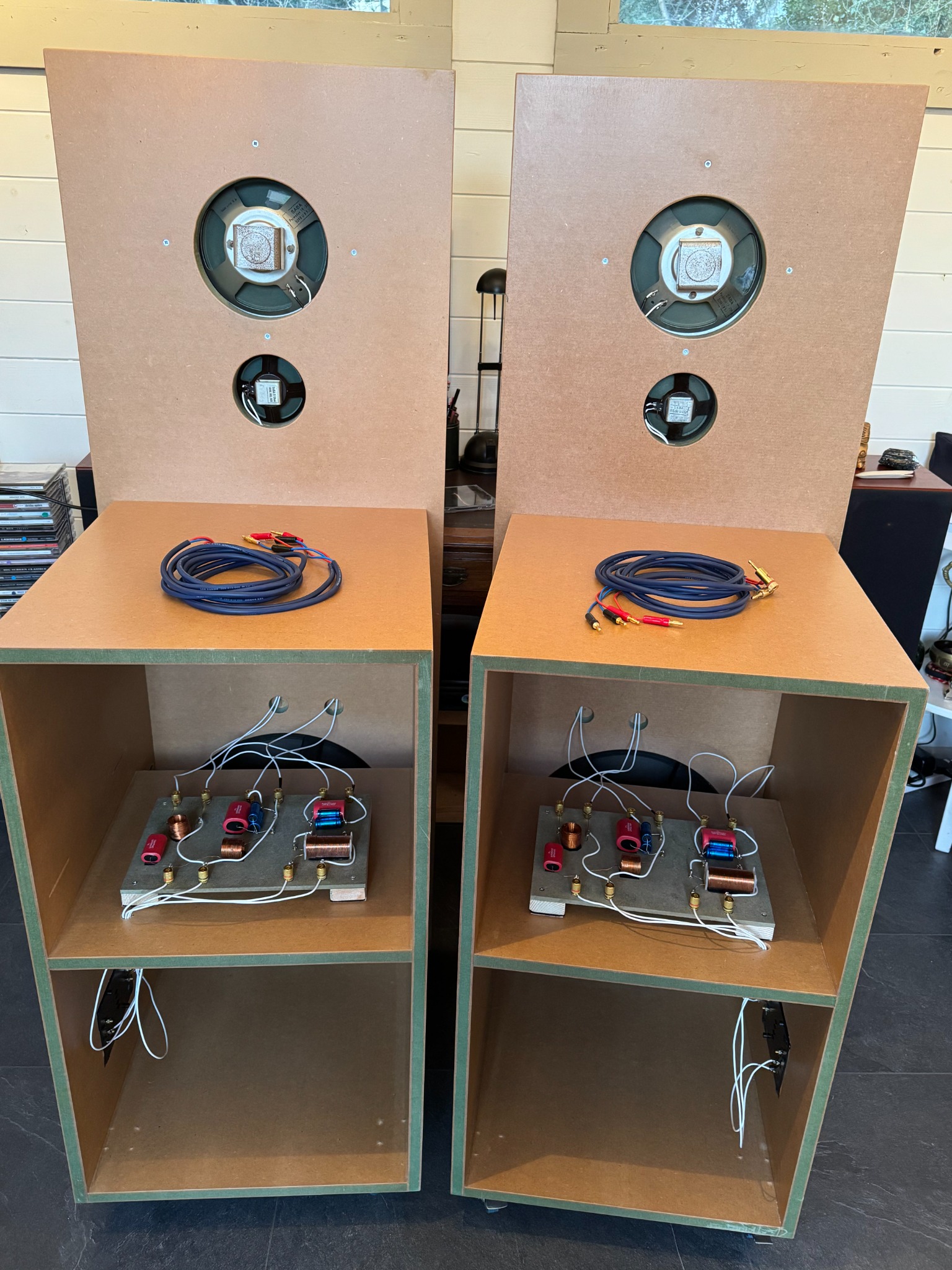
The rear wave is part of the design.
Where a conventional box tries to manage or suppress rear radiation, P17 lets a meaningful part of it participate in the listening space.
That can contribute to a sense of depth and scale because the room receives energy from both sides of the radiating system. It can also make placement more consequential. Distance from boundaries, toe-in and listening geometry influence the balance between direct sound and reflected field.
For Luke, the value is not a theatrical “big soundstage”. It is the possibility of images existing within a volume of air, with reverb and atmosphere joining the direct sound rather than being pasted behind it.
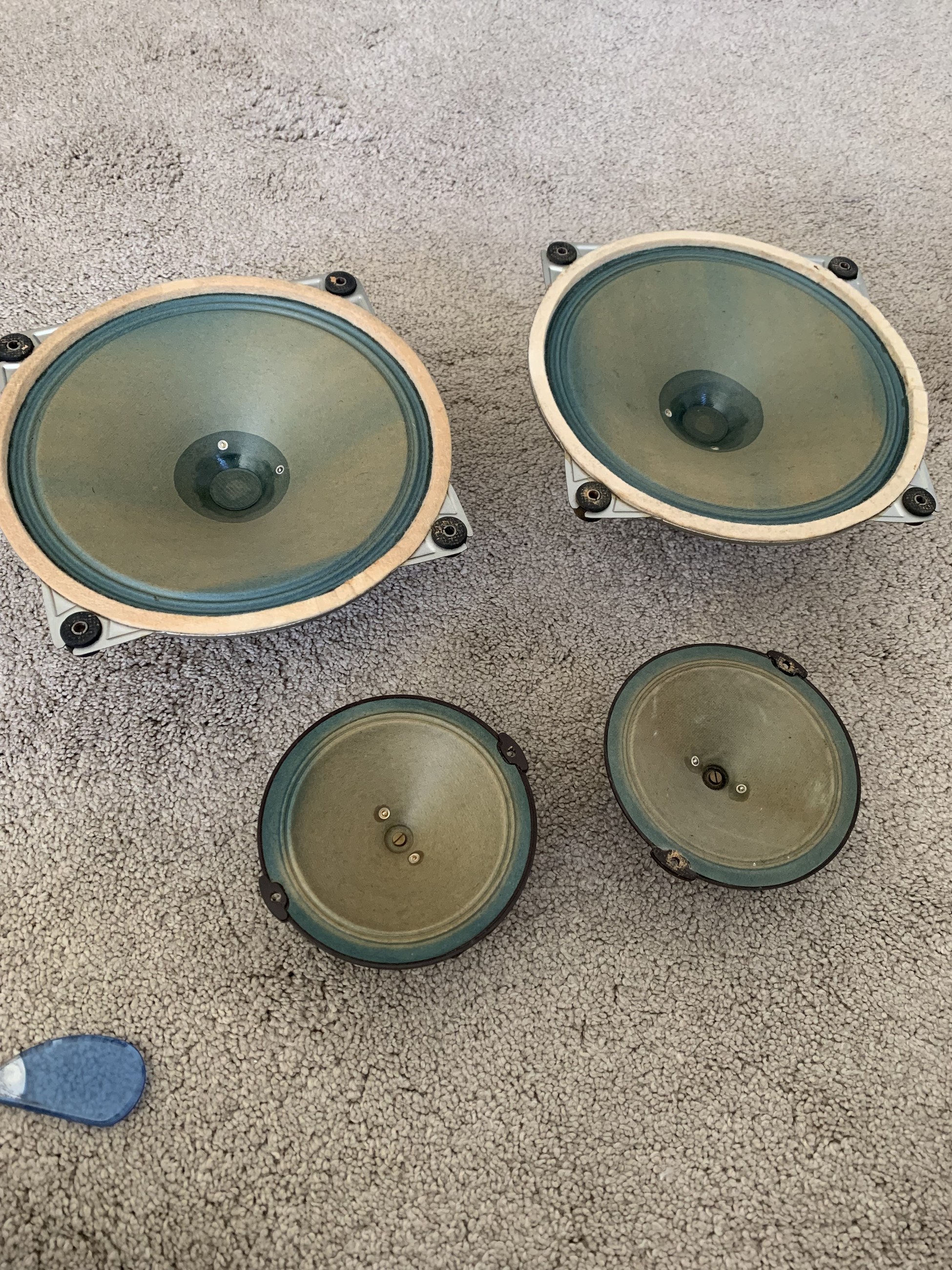
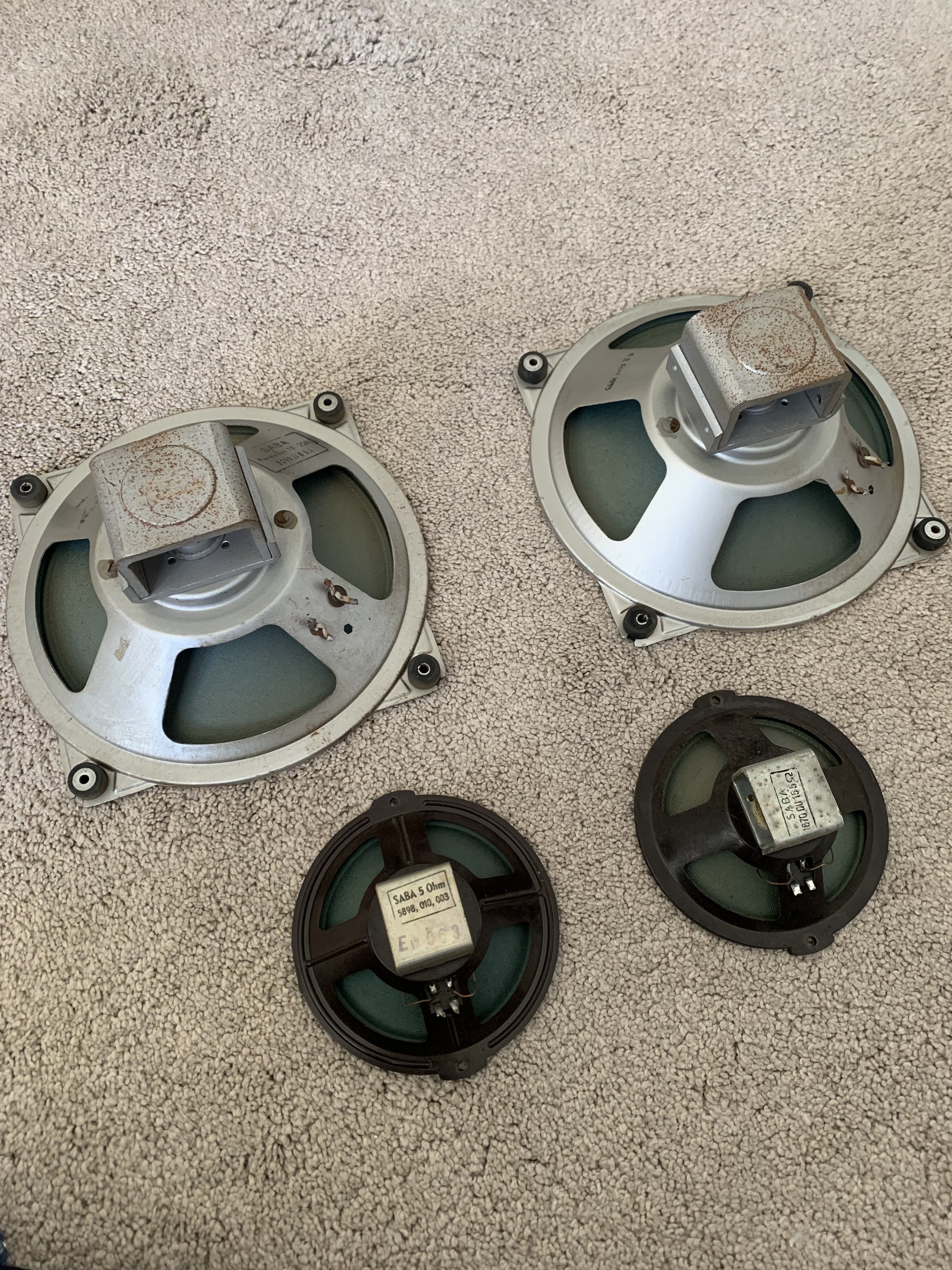
20 cm midrange. 10 cm high-frequency paper cone.
Why the 20 cm SABA matters
Much of the emotional identification of a recording sits in the midband: voice, strings, guitar, piano harmonics and the cues that tell us what an instrument is made from. The SABA’s low-mass paper construction is used for immediacy and human texture rather than for an abstract vintage aesthetic.
Why the 10 cm SABA high-frequency driver matters
The 10 cm paper high-frequency cone preserves a related material character through the handover from the 20 cm midrange. The result can feel unusually coherent through voice and presence, even if a modern ribbon may ultimately offer more extension, speed or apparent air.
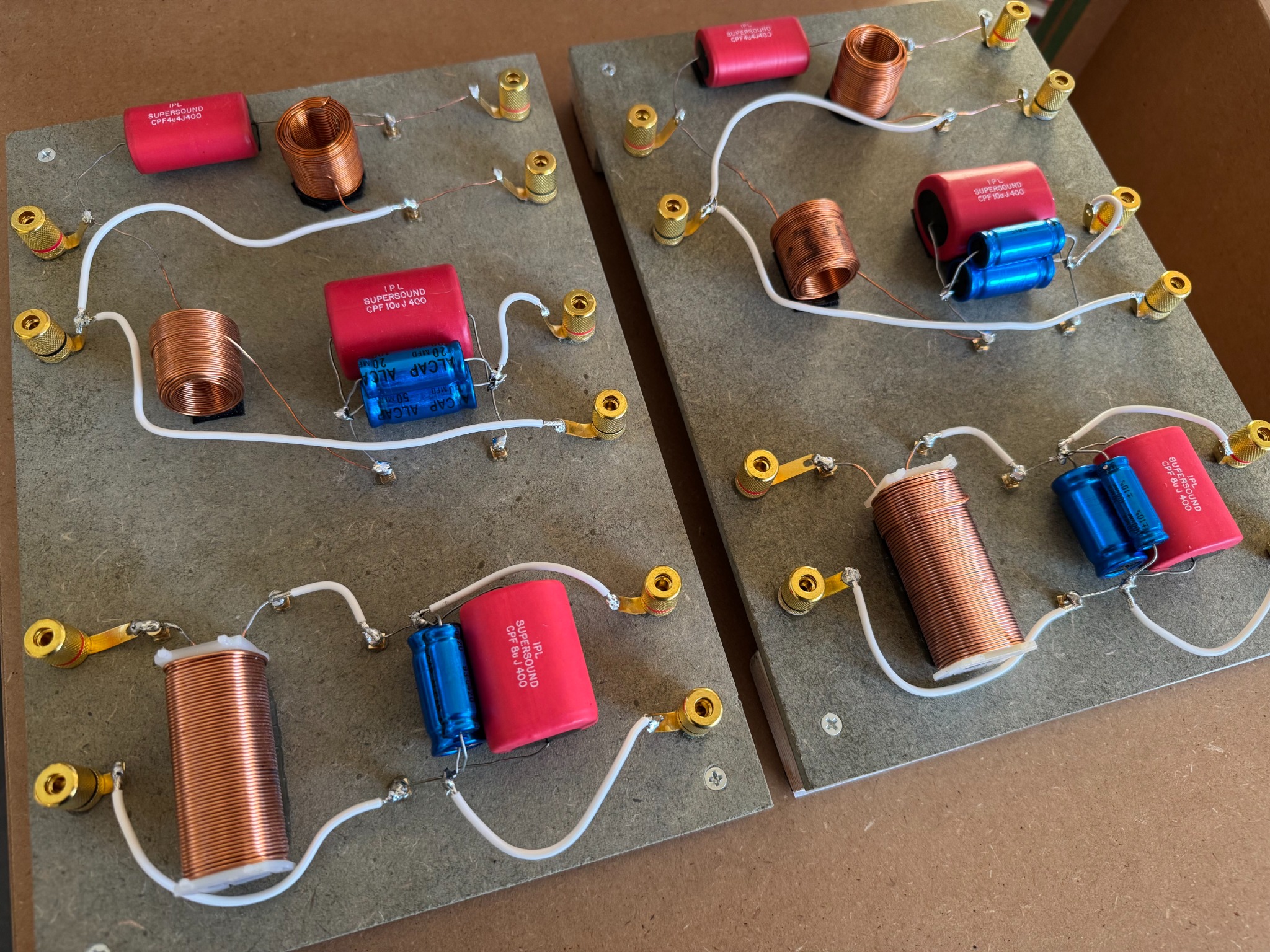
A network is a voicing junction, not an afterthought.
The completed pair uses hand-built boards, selected/custom IPL Acoustics components in places, silver-plated internal wiring and a documented second-order tweeter element using a 0.39 mH inductor with 4 µF series capacitance.
Crossover work decides far more than “which frequencies go where”. Level, phase, overlap, impedance interaction and component behaviour all affect whether three physically different radiators become one believable source.
That is why future component changes are treated as development routes, not automatic upgrades.
From premium parts to intelligent allocation.
The crossover research is best understood as four stages. The important conclusion is not that the most expensive network won on paper, but that later work became more selective about where exotic capacitors were likely to matter most.
ODAM + CuTF becomes the mature choice
The later preferred route keeps the 4 µF V-Cap ODAM with 0.1 µF CuTF bypass. This is where the research most consistently justifies exotic expenditure: air, microtexture, transient cleanliness and decay are pursued while preserving the 10 cm SABA paper cone's body and continuity with the 20 cm driver.
ClarityCap CSA, 80 µF total
The no-compromise branch explored four 20 µF ODAMs. Later optimisation stepped back from that cost and retained 80 µF of ClarityCap CSA, later expressed in the system masters as a 2 × 40 µF implementation. The reasoning was not compromise for its own sake: CSA was already judged highly natural and open, with diminishing return from moving the entire value to ODAM.
Monacor MKP, 68 µF
The bass path ultimately becomes the clearest example of proportionate spending. Correct value, low loss and integration with the McKenzie matter more than boutique branding. The later preferred research therefore keeps a 68 µF Monacor MKP rather than carrying ODAM into a very large, expensive bass value.
The IPL/Alcap crossover is the only network with a completed listening diary. Every later route must be judged against the musical whole it already created.
Earlier work picked up the Lampizator maximised-network principle: Mundorf Supreme at the tweeter, ClarityCap through the midrange, and less extravagant parts in bass.
The 2023 V-Cap discussion preserved an all-out possibility with ODAM extending through midrange and bass as well as ODAM/CuTF at the top.
By the later 2025 documents the preferred researched balance becomes ODAM/CuTF → ClarityCap CSA → Monacor MKP. The most expensive branch remains historically important, but is no longer presented as the automatic endpoint.
Paper versus ribbon: where the capacitor choice becomes philosophical
The RAAL route would change the radiator and therefore requires a new acoustic/electrical design. The paper-cone route asks a subtler question: can the 10 cm SABA keep the density and material continuity it shares with the 20 cm SABA while the ODAM/CuTF network unlocks more air, fine decay and spatial information? The goal is not to make paper imitate a ribbon, but to close some of the refinement gap without losing the quality that made the paper pairing special.
RAAL is a new engineering branch, not a drop-in upgrade.
A future bespoke P17 could explore a RAAL 140-15D ribbon route. That would be a different version of the loudspeaker, requiring crossover redesign and proper matching of sensitivity, level, phase, acoustic centre and dispersion.
What could be gained
Potentially greater treble extension, transient delicacy, fine atmospheric retrieval and a different sense of “speed”.
What must not be lost
The human density, mid/treble continuity and coherence that make the SABA paper pairing the identity of the reference P17.
Any ribbon version would be prototyped and voiced as a separate commission path. No claim is made that it would automatically be “better” than the reference paper-cone version.
The strongest commission is the one whose choices serve the room and the listener.
Every route gains something and risks something.
| Choice | What it can support | What must be watched |
|---|---|---|
| Large dipole bass | Scale, low stored energy, room integration | Placement, cancellation, available excursion |
| SABA paper mid/high | Tonal continuity, speed, human density | Extension, condition of vintage drivers, level matching |
| Premium crossover caps | Potentially lower loss / different low-level presentation | Value accuracy, cumulative voicing, cost without guaranteed benefit |
| RAAL ribbon branch | Extension, transient delicacy, dispersion characteristics | New crossover, sensitivity, phase, acoustic centre, preserving mid/treble continuity |
The progression is electrical, financial and philosophical.
| Band | 1. Reference • built/heard | 2. Lampizator premium idea | 3. Full V-Cap exploration | 4. Mature researched route |
|---|---|---|---|---|
| 10 cm high frequency | 4 µF IPL Supersound | Mundorf Supreme | 4 µF ODAM + 0.1 µF CuTF | 4 µF ODAM + 0.1 µF CuTF |
| 20 cm midrange | 70 µF Alcap + 10 µF IPL | ClarityCap | 4 × 20 µF ODAM | 80 µF ClarityCap CSA (later master: 2 × 40 µF) |
| 15-inch bass | 60 µF Alcap + 8 µF IPL | Pragmatic/lower-cost allocation | 2 × 33 µF ODAM selected towards ~68 µF | 68 µF Monacor MKP |
Only the reference network is built and heard. Stages 2–4 are preserved as research evolution. Stage 4 is the later preferred researched configuration, not a completed listening result.