Holography needs body
Luke’s notes use “holographic” when images stop behaving like points on a line. A voice has a centre but also thickness. A drum strike has attack, shell tone and room. Reverb tells you something about distance. The system lets you move attention between those things without collapsing the song.
Depth without image body can feel like an effect. Body without air can feel congested. Holography is what happens when neither has to be sacrificed.
Why dipoles are interesting
With a dipole, the rear wave is not locked inside a box. It interacts with the room after a time delay, so placement and boundaries become part of the acoustic result. That can support depth and spaciousness, but it can also blur the presentation if positioning is careless.
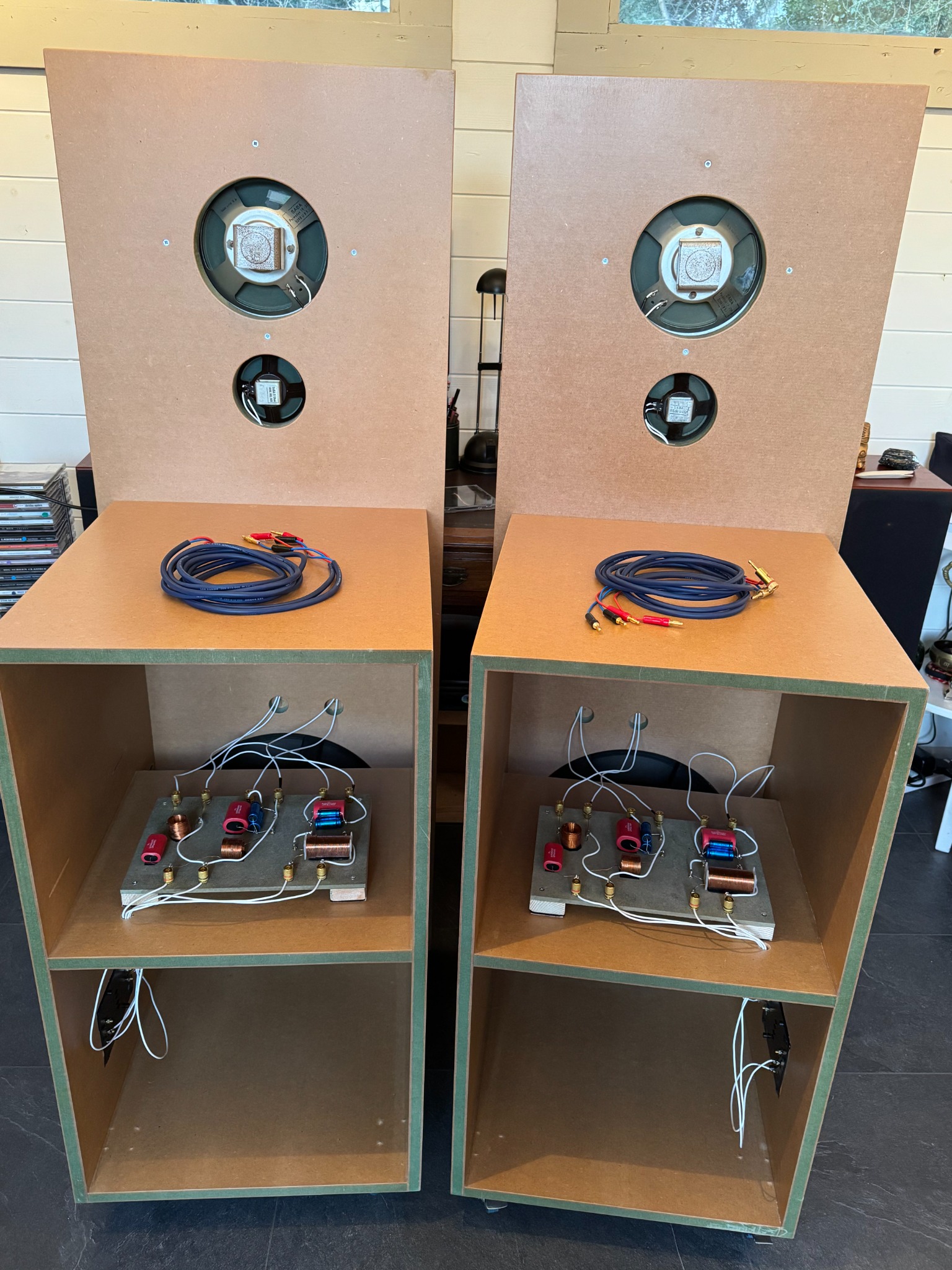
P17 therefore treats placement as part of the design. The 15-inch bass driver and the SABA section both live in an architecture where front/rear radiation relationships matter.
The room is not an accessory
There is no universal distance-from-wall number because rooms differ. The practical principle is simpler: give the rear radiation enough time and space to contribute without swamping the direct event. Toe-in, listener distance and symmetry then become voicing controls.
The room is not an error term
P17’s rear radiation means placement changes the ratio between direct energy and the reflected field. Distance from the front wall, toe-in and listening position therefore become part of the speaker rather than housekeeping performed after the design is complete.
But dipole radiation does not guarantee holography
A large, spacious presentation can still be flat. The system needs image density, timing, decay and tonal body so that a voice has shape inside the room rather than becoming a pin-point between the cabinets.
This is why the archive’s portable examples matter. D-211, OPA445BM, GE valves and M15i Blue can all produce aspects of holography without a dipole loudspeaker. The speaker/room architecture can enlarge the phenomenon, but the source and analogue stages still have to preserve the cues.
The target is a believable volume, not maximum width
The repeated preference is “whole track + intimacy”: enough spatial information to inhabit the recording, enough body that the people inside it do not dissolve into soundstage effects.