A system is a set of relationships.
The later archive formalised something the earlier experiments had already shown: the most important component may be the relationship between components.
Do not optimise every box for the same trait.
If every stage is chosen for maximum warmth, the result can close in. If every stage is chosen for maximum explicit detail, the result can become skeletal. Synergy is the art of distributing virtues and compensating weaknesses across the chain.
Preserve life at the source
Luke repeatedly gravitates towards sources with timing, body or immediacy already intact, then refines downstream rather than trying to add life back after it has disappeared.
Use stages as perspectives
Valves, op-amps, power supplies and headphones are treated as ways of changing proportion: more air, more body, more grounding, more intimacy, more speed.
Let the loudspeaker expose the relationships
The P17 is intended to be sufficiently open and dynamic that upstream differences remain audible without turning every change into a forensic exercise.
| Element | Potential contribution | Potential excess | Balancing move |
|---|---|---|---|
| Raw multibit source | Texture, immediacy, tonal density | Thickness or roughness | Cleaner analogue stage, power or amplification |
| Valve stage | Body, dimensional flow, human phrasing | Softness or excess bloom | Neutral power stage, careful bias and coupling |
| Highly resolving op-amp | Edge definition, space, micro-information | Analytical emphasis | Warmer source/headphone or fuller coupling stage |
| Open loudspeaker | Scale, depth, reduced box impression | Placement sensitivity | Room-aware positioning and level integration |
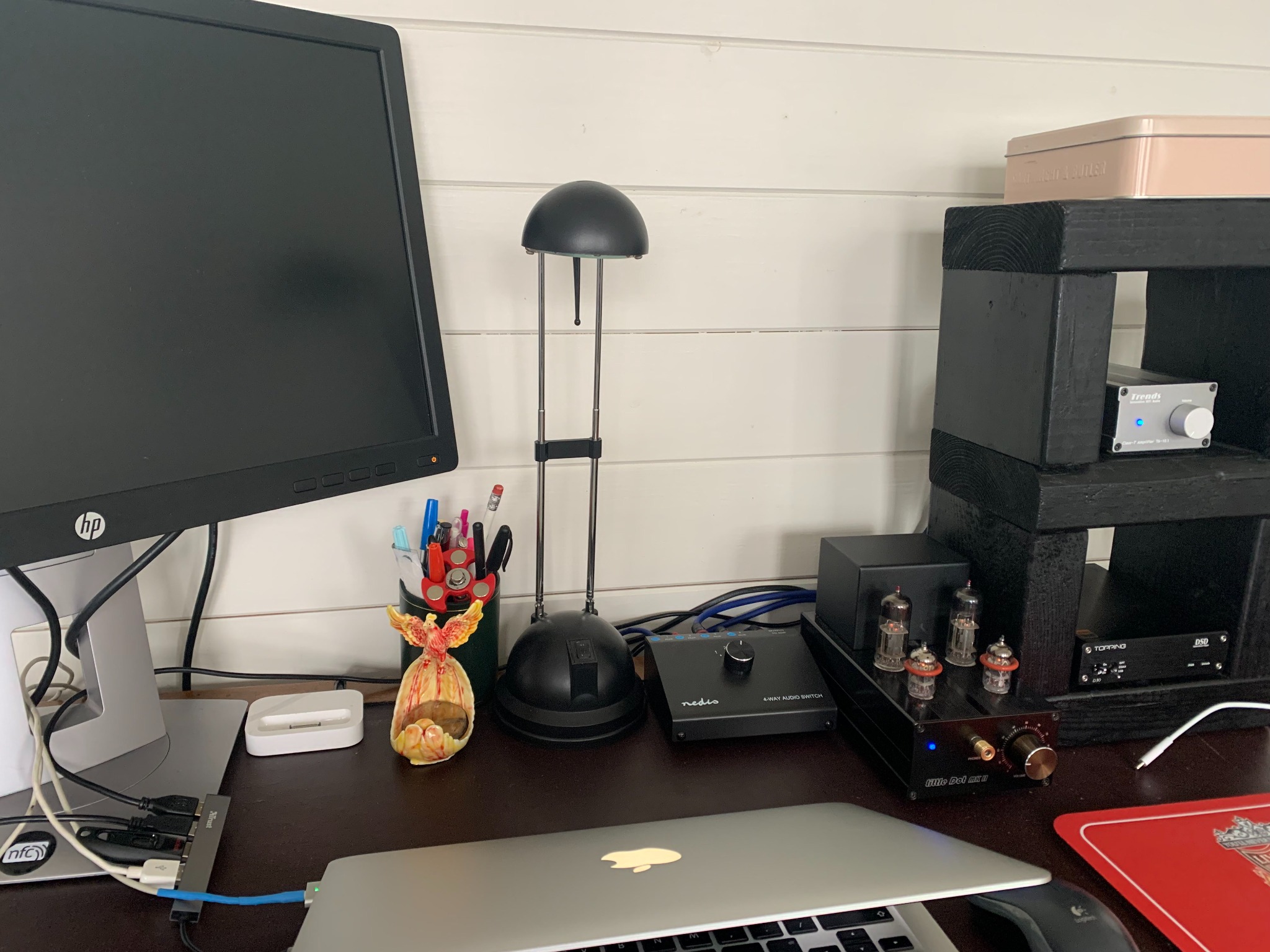
The principle did not start with an endgame system.
Philips TDA1549, the 6N16B-V MikroLampizator stage, Little Dot MKII and Trends Audio 10.1 each brought a different architecture. The learning came from how they behaved together.
Similarly, portable comparisons using Grado, Sennheiser, iPod, Sony D-211, Askew and different op-amps created a miniature version of the same experiment. The repeated lesson was that a “better” individual component can be a worse system choice.
The mature system documents stop asking which component is “best”.
They ask what each stage contributes, what it risks exaggerating, and which next stage should preserve or rebalance that character.
Three source voices were explored because one voice was not enough.
The later master-system narratives repeatedly group TDA1541, PCM1798/6N16B and PCM63/M24 as complementary rather than mutually exclusive. In that model the TDA1541 branch carries raw/emotional energy, PCM1798 becomes the deliberately integrated hybrid, and PCM63 is the structural/resolution branch. Whether those roles survive actual ownership and listening is a future question, but the architecture explains why the system remains modular.
The preamp-first decision keeps those branches possible.
Moving volume and source control into a dedicated valve stage allows power amplification to be selected for drive and preservation rather than convenience. It also avoids rebuilding the system whenever a new DAC or analogue source enters.