Signal path
The archive gradually moves from cable choices towards circuit relationships. A signal path is not “pure” because it is short. It is good when every stage has a reason to exist and the electrical relationships let the musical information survive.
The shortest signal path is not automatically the best signal path.
The later master notes crystallise an idea that had already appeared in the D-211, D30, Little Dot and P17 work: every connection has an electrical job. Removing a stage helps only if the remaining chain still provides the loading, gain, isolation and drive the system needs.
Loading
Input impedance, output impedance and cable capacitance belong to the circuit, not to an accessories list.
Grounding
Star grounding, return paths and the separation of heater, digital and analogue currents are treated as implementation issues.
Control
Selectors, attenuators and bypasses are designed around what must remain connected during switching, not only around convenience.
S/PDIF is an electrical interface before it is a cable brand.
The master notes preserve the practical preference for roughly 1.5 m or longer coaxial S/PDIF where interface reflections are a concern, rather than assuming the shortest cable is always ideal.
WM8804-based receiving and isolated USB-to-S/PDIF conversion appear repeatedly as ways of treating jitter/noise at the interface rather than asking the DAC chip to solve everything.
A late-2025 master note explores silver-mica S/PDIF coupling in the 6N16B/PCM1798/M24 system. It remains a research option until implemented and compared.
Sony and Arcam transports are considered as sources into external DACs as well as complete players, preserving a modular path through the system.
Material choice is subordinate to geometry and circuit role.
Silver-plated internal wire, Vandamme cable, copper speaker cable, silver solder and future solid-silver branches all appear in the archive. The mature view is not “silver is better”.
P17 deliberately uses silver-plated internal wiring while retaining high-quality copper externally in some configurations. The point is system balance, mechanical reliability, resistance and the behaviour of the whole chain. A later Silver Conduction Theory narrative is therefore preserved as research context rather than proof that conductor material alone determines sound.
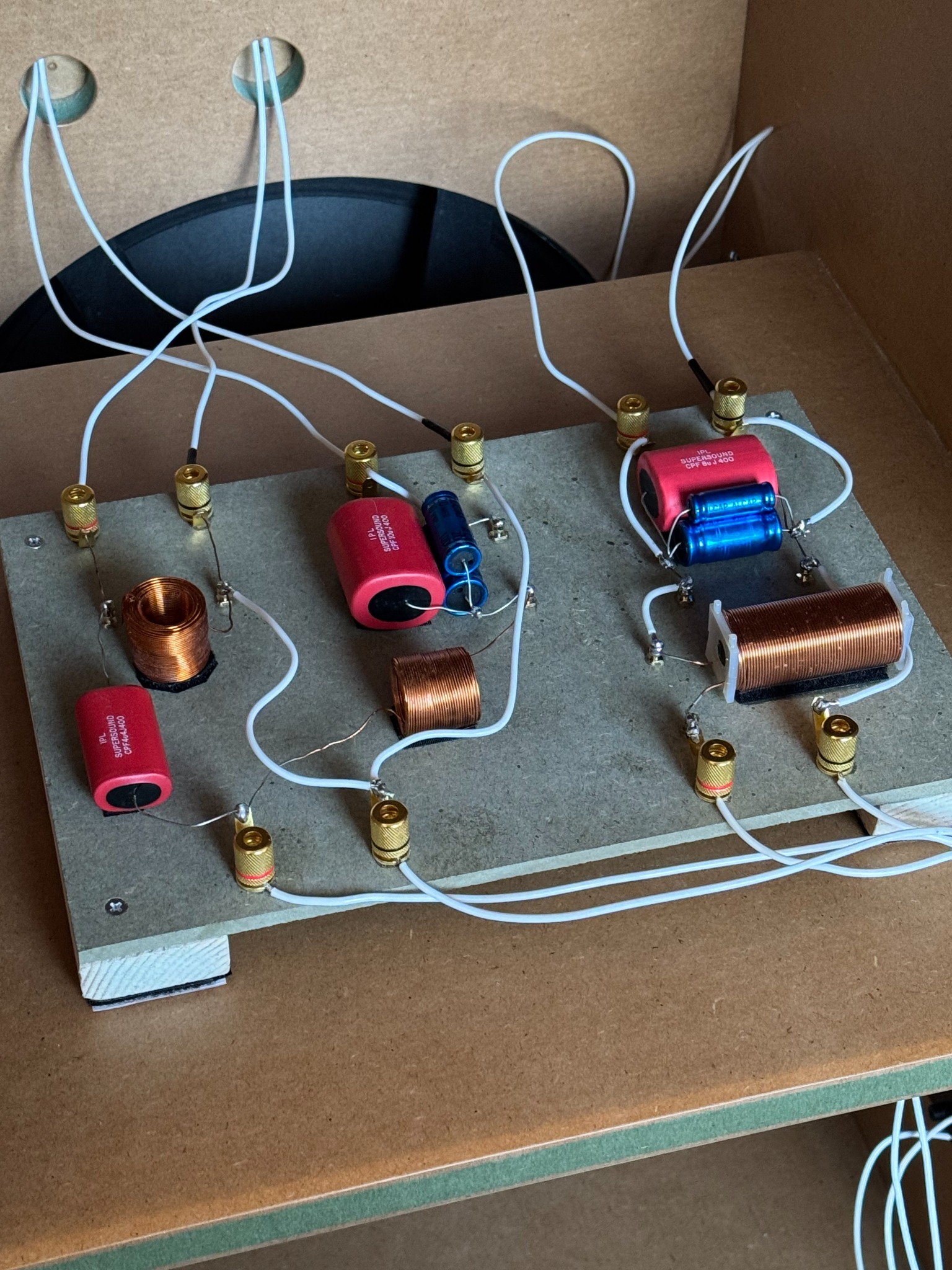
Source selection is part of circuit design.
The 6N16B DAC/preamp research turns what looks like a front-panel convenience into a real topology question.
DAC current-output loading, line-level input reference resistors, a grid reference while contacts move, fixed-versus-variable output and attenuator bypass all have to coexist. The same philosophy appears at a simpler level in the Trends volume bypass and the Little Dot becoming the system’s single control stage.