Op-amps
Op-amp rolling became one of the clearest ways to hear that “solid state” is not one sound. The point was never chip collecting. It was learning how intimacy, grounding, speed, image density and whole-track coherence change inside a real chain.
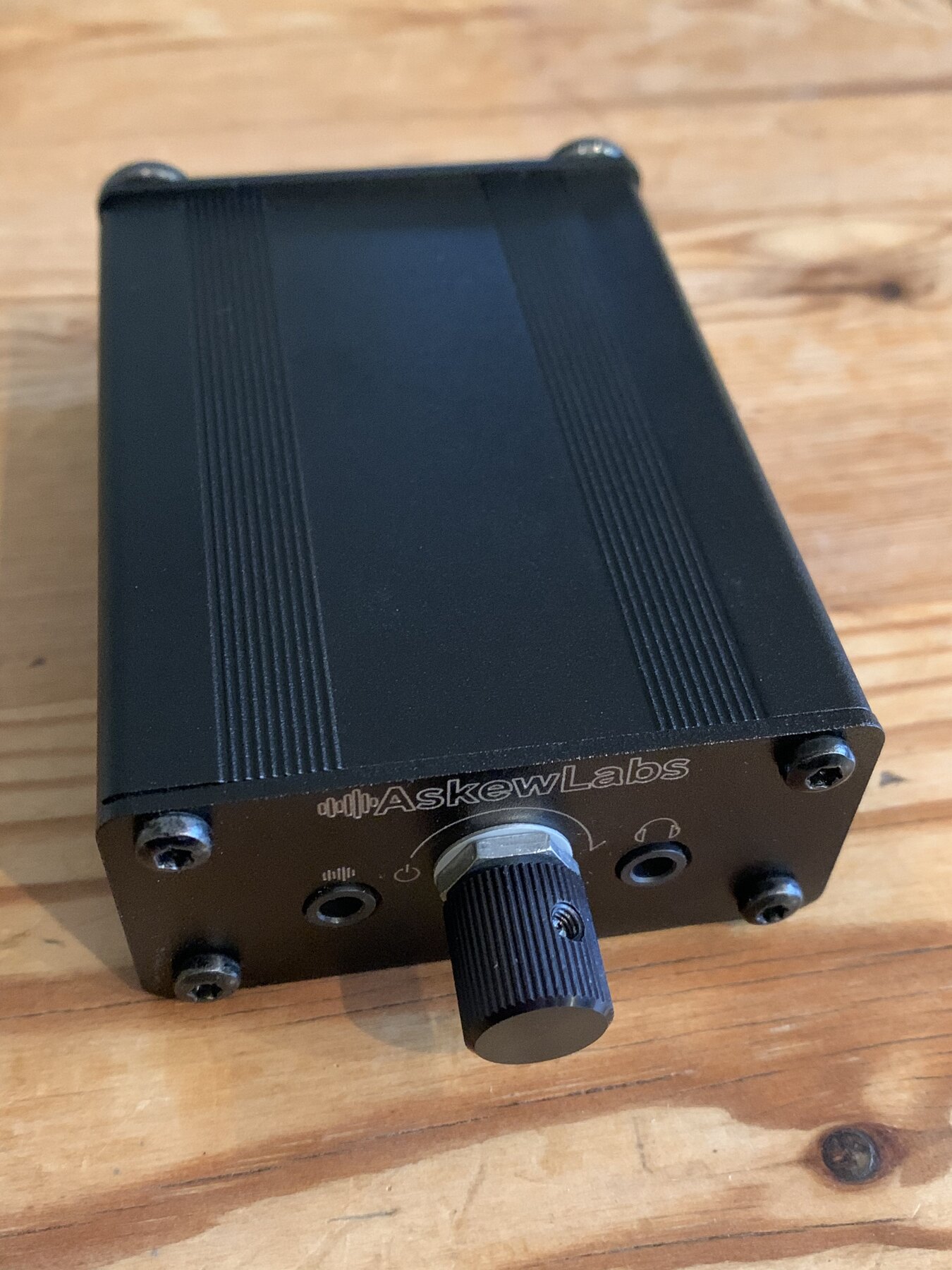
A socket became a listening laboratory.
The Askew Labs CMOY and Topping D30 made op-amp changes unusually easy to compare without rebuilding an entire source.
The original TLE2082 established an open, balanced baseline. AD825 moved the emphasis towards speed, transparency and a more exposed midrange. LME49860 became one of the early holography references. ADA4627-1BRZ later brought intimacy and low-level insight without giving up musical flow. The rare OPA445BM metal-can pair became the fuller, more grounded expression of the same wider philosophy.
These are listening descriptions from specific chains, not claims that one device has a fixed sound in every circuit.
Different chips, different jobs.
| Op-amp | Recorded tendency in Luke’s systems | Where it made most sense |
|---|---|---|
| TLE2082 | Open, balanced, detailed; an early all-rounder. | Original Askew baseline. |
| AD825 | Fast, lively, transparent, unveiled; less emphasis on bass weight. | Askew and D30 comparison point. |
| LME49860 | Very spacious, layered and live-feeling in the 2021 listening notes. | Askew + iPod / Momentum / Grado experiments. |
| ADA4627-1BRZ | Intimate, detailed, “private performance” presentation without becoming sterile. | Askew portable reference; particularly useful with HD25/HD600-type listening. |
| OPA445BM metal can | Fuller, grounded, smooth, harmonically complete and large-scale. | D30 and occasional Askew experimentation; later a key home-system reference. |
| OPA2134 | Neutral stock D30 baseline. | Useful control before power-supply and op-amp changes. |
Askew + BRZ and D30 + OPA445BM do not need to sound the same.
Askew + ADA4627-1BRZ
Portable, intimate, finely layered and especially natural with the older iPod sources. The later system notes treat it as a dedicated-listening combination rather than something superseded by the M15i.
D30 + OPA445BM
Home-system scale, body and grounding. Once paired with the iFi power supply and later Little Dot stage, it became a route back into serious headphone listening from the computer/streaming source.
The 2026 master narrative makes an important correction to simple “upgrade” thinking: Blue M15i, Askew/BRZ, D30/OPA445BM and the iPods occupy different roles. A new component does not have to erase the reason an older chain exists.
The analogue stage is part of the instrument.
The shortest path is not automatically the most convincing path. The useful question is whether a stage preserves timing and truth while adding the drive, impedance behaviour or harmonic completeness the following load needs.
The same op-amp can behave differently with another source, supply, headphone or downstream valve stage.
More edge information only counts if image body, phrasing and whole-track coherence remain intact.
The D30 experiment separated the stock PSU, iFi supply and op-amp changes so that the analogue IC was not asked to explain every sonic difference.
BRZ and OPA445BM remain useful precisely because they illuminate different aspects of the same musical target.