Amplification
The archive treats amplification as the last translator in a chain, not as a badge. The progression moves from a modified Trends power stage through Temple and SET branches to a later Class-A Monarchy direction, while keeping built experience separate from future research.
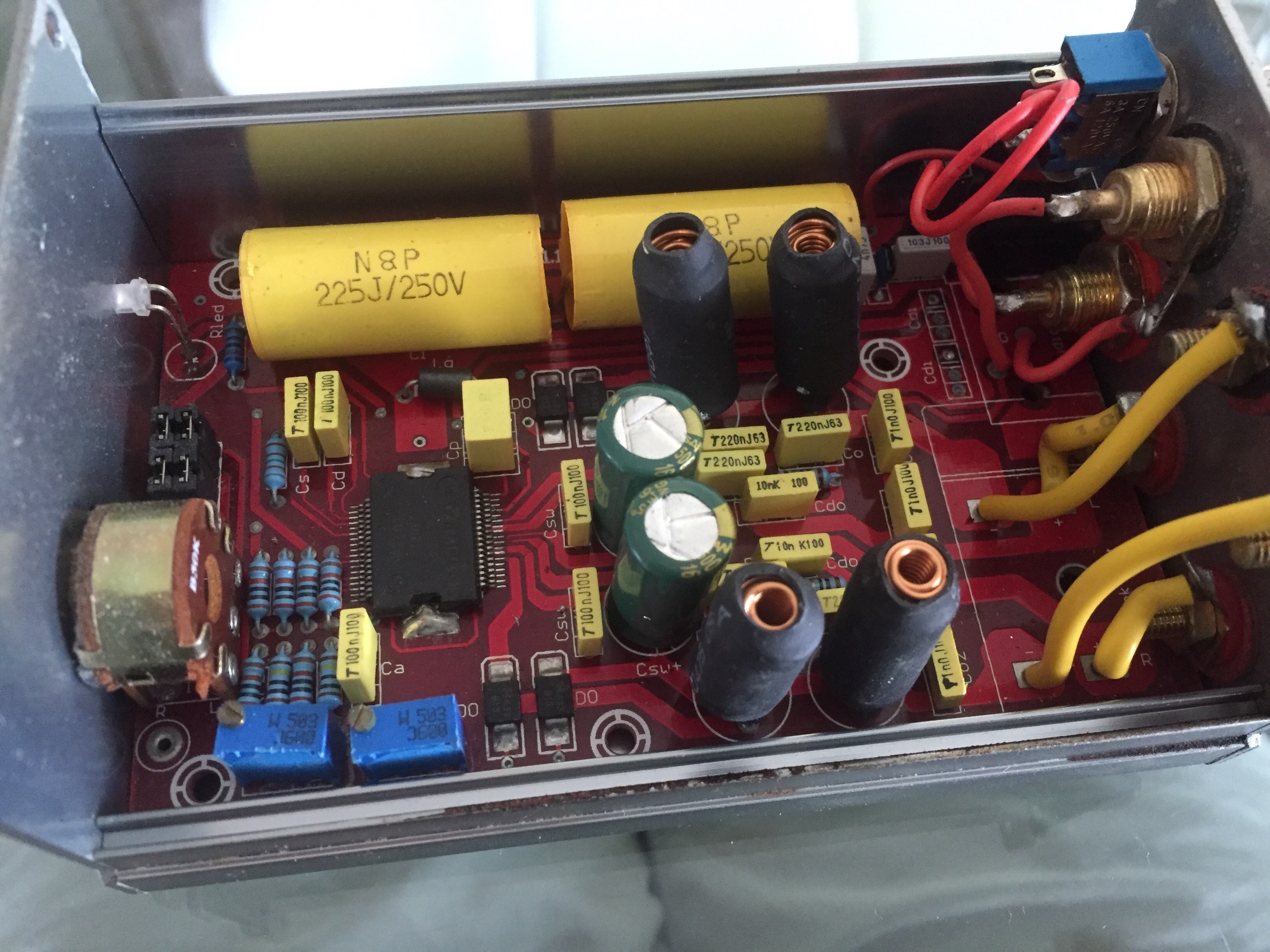
The power-stage lesson started small.
The Trends Audio TA-10.1 became useful precisely because it stopped trying to be the control centre.
The amplifier began as a compact Tripath integrated. Over time the scratchy 50 kΩ control was replaced, the PCB repaired, DC bias reset, and the second volume control ultimately bypassed so the unit could work as a power amplifier behind the Little Dot MKII. That shift is important: once the preamp became the centre of the system, every downstream amplifier could be judged on how well it preserved the source and line-stage character.
Power experiments followed the same logic. A 12 V gel battery and later filtered supply ideas were explored because the small amplifier made supply changes easy to isolate.
Integrated amplifier → clean power stage → specialist branches.
Temple Bantam / Temple monoblocks
Battery and Supercharger-powered Temple amplification became an attractive branch because the research sought low noise, speed, compactness and enough control for the P17 without adding another strong tonal signature.
Temple on bass, SET above
A November 2025 branch kept Temple control on the 15-inch bass while exploring 2A3 or 300B single-ended triodes for the SABA mid/high section. It is preserved as a design direction, not a listening result.
845 / 211 / GM70 / Cary
Large DHT and SET amplifiers were studied for a different route: enough authority for full-range duties while retaining triode texture and spatial bloom. Music Angel 845, Cary 805, 2A3, 211 and GM70 all appear in the progression.
Dual Monarchy SM-70 Pro
The late-2025 master documents shifted the preferred research endpoint towards two Monarchy SM-70 Pro amplifiers in mono unbalanced operation, prioritising Class-A texture, drive and a preamp-first architecture.
6N16B or M24 upstream
The power stage is deliberately downstream of the personality-setting elements. The planned 6N16B line stage and the Monarchy M24/autoformer branch can each become the control centre without requiring an integrated amplifier.
Power should complete, not overwrite
The archive repeatedly returns to the same test: the amplifier should preserve timing, body, image density and the chosen source character while providing enough grip for the loudspeaker.
Different power stages answer different system problems.
| Architecture | Why it entered the research | What it would need to prove | Status |
|---|---|---|---|
| Trends TA-10.1 | Simple, efficient, transparent enough to expose source/preamp changes. | That bypassing redundant control and improving supply behaviour really benefits the whole chain. | Built / heard |
| Temple monoblocks + Superchargers | Low-noise, fast, compact power with an unusual PSU concept. | That control and image precision remain musically complete through P17. | Explored |
| 2A3 / 300B bi-amp | Add triode texture above the bass while retaining solid-state grip below. | Level matching, crossover interaction, noise and whether two amp characters still sound like one speaker. | Explored |
| 845 / 211 / GM70 / Cary 805 | Full-range DHT scale and tonal density. | Noise, heat, transformer quality, bass control and whether added character is genuinely useful. | Explored |
| 2 × Monarchy SM-70 Pro | Later Class-A endpoint in the research. | Real P17 drive, heat, input matching and whether the theorised texture/control balance survives listening. | Explored |
The amplification page preserves the sequence rather than replacing early branches with the latest preference.
The first job is measurement. The second is forgetting the amplifier.
Confirm the real sensitivity and input impedance against the 6N16B or M24 control stage so the volume range and noise floor make sense.
Use the P17 bass driver and full network as the test, not an abstract amplifier benchmark.
Class-A and large-triode branches must work safely in the actual listening room, not only on paper.
The winning branch is the one that leaves the source differences intact and makes the loudspeaker disappear more completely.