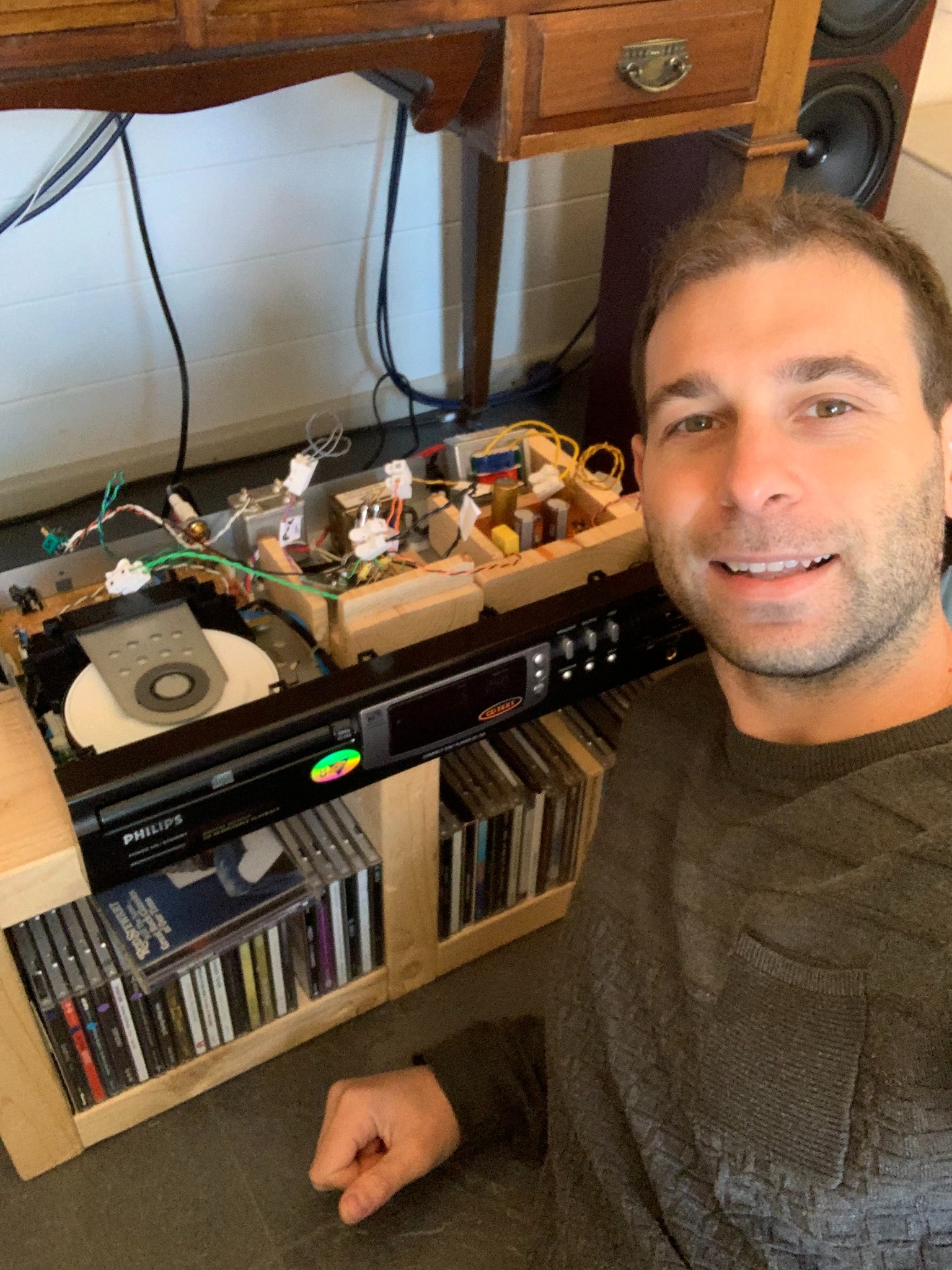
The TDA1549 experiment
The Philips CD753 began as a modest commercial player. A hand-built MELZ 6N16B-V SRPP stage changed the analogue path after conversion. The immediate reaction was not “warmer”. It was organic, dynamic, real, truthful and non-fatiguing.
Why that matters
It shifts attention away from endless chip ranking. A DAC’s power, analogue stage, output impedance, coupling, downstream preamp and recording can matter as much as the silicon headline.
Digital can be analogue in behaviour without pretending to be vinyl
The goal is not to make CD imitate a record. It is to preserve timing, harmonic structure, decay and dynamics so that digital stops advertising itself as a process.
The first proof was the CD753
The Philips project did not begin with an expensive DAC board. It began with a TDA1549 player that already worked and a decision to change what happened after conversion. The 1988 MELZ 6N16B-V SRPP stage created a direct experiment in output-stage behaviour, then remained useful enough to feed the Little Dot and later help judge P17.
The next project separates the roles more deliberately
The planned PCM1798/6N16B build takes the same insight and turns it into architecture: the DAC board is one subsystem; direct I/V and valve gain are another; line input, fixed/variable volume and power supply are designed around the stage rather than added after the fact.
The high-voltage plan itself becomes part of the audio design: approximately 180 V AC into bridge rectification, 120 µF reservoir, 20 H choke, another reservoir, 2.2 kΩ damping/drop and a final reservoir node modelled around 220 V under load. Until built, that remains an electrical plan rather than a sonic result.
“Valve output” is therefore too broad a category
A tube can sit behind an op-amp, perform gain, perform I/V, buffer another stage or control the whole system. Heater supply, cathode bias, load, output coupling and downstream impedance all change what that valve is actually doing. The site’s valve philosophy is really an output-stage philosophy.