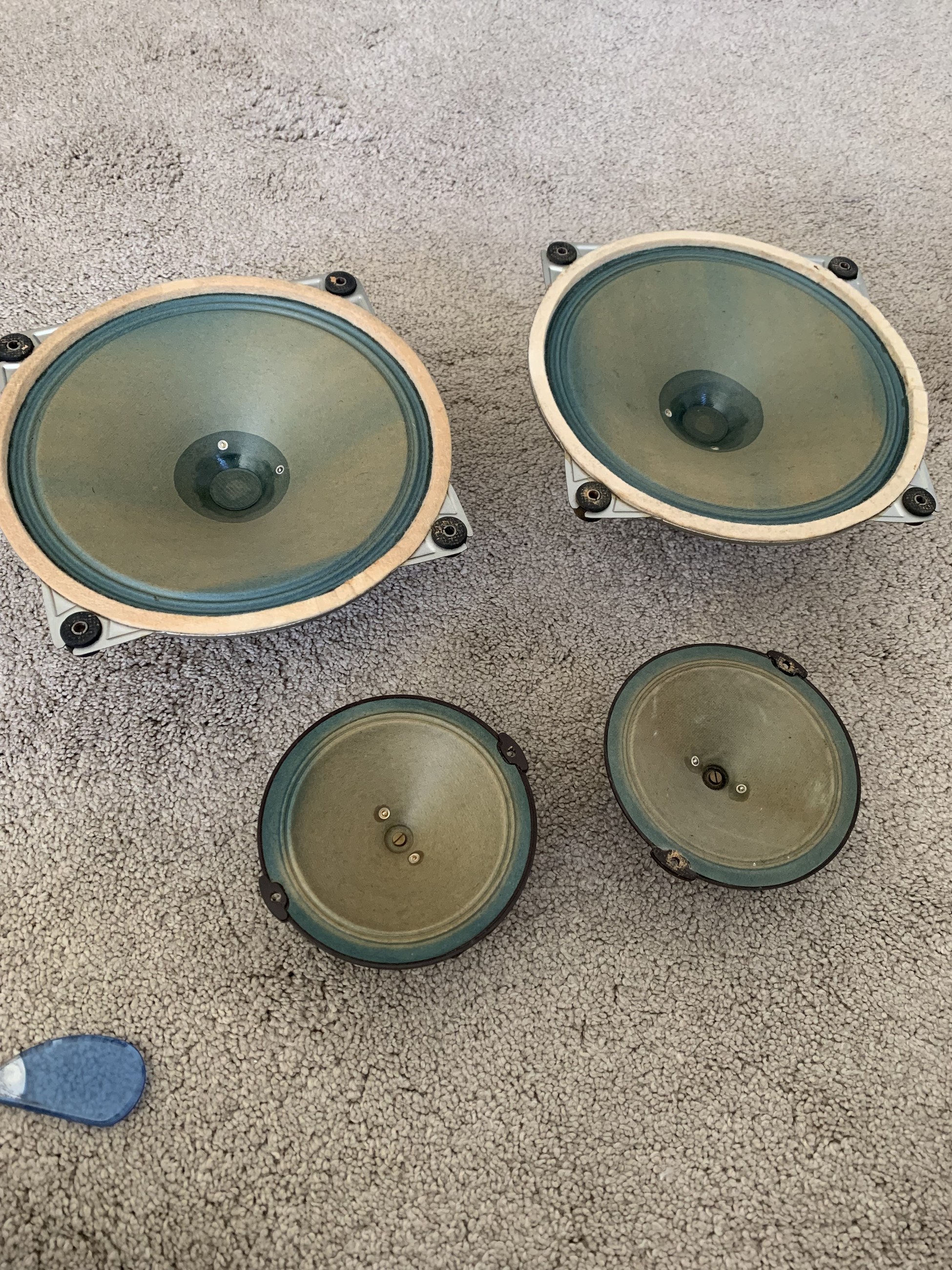
20 cm + 10 cm: why the paper pairing matters
The finished P17 uses a 20 cm SABA paper-cone midrange and a 10 cm SABA paper-cone high-frequency driver. The 20 cm unit supplies much of the vocal and instrumental body; the 10 cm unit carries that related paper character upwards. Their shared material continuity is central to the reference because the handover does not introduce an obviously separate tweeter material or presentation.
The Lampizator premium idea came first
The earlier Lampizator loudspeaker material helped establish a hierarchy of where premium crossover money was likely to matter most. Its maximised-network thinking put Mundorf Supreme on the tweeter and ClarityCap through the midrange, while allowing the bass section to remain more pragmatic. That was not yet Luke's final P17 recipe, but it became an important design principle: spend according to acoustic influence, not according to symmetry or price prestige.
Then came the cost-no-object V-Cap thought experiment
The 4 May 2023 V-Cap correspondence pushed the idea much further: 4 µF ODAM with 0.1 µF CuTF at high frequency, four 20 µF ODAM capacitors for 80 µF midrange, and two 33 µF ODAM capacitors selected towards roughly 68 µF in bass. This is the most extravagant preserved branch and remains useful because it tests the logic of taking premium dielectric choices through the whole network.
The later optimisation became more selective
By the February and November 2025 master documents the preferred researched P17 route was no longer simply “more ODAM”. It settled on 4 µF ODAM + 0.1 µF CuTF for the 10 cm SABA, 80 µF ClarityCap CSA for the 20 cm SABA, and 68 µF Monacor MKP for the McKenzie bass. Later system notes express the midrange total as a practical 2 × 40 µF arrangement.
The reasoning is important. ODAM across the entire 80 µF midrange could be attractive, but the likely return over a very good CSA network was judged small relative to cost. In bass, the argument was stronger still: correct value, low loss and integration matter, but boutique ODAM pricing offers very poor return at such a large capacitance. The mature conclusion is therefore selective maximalism, not blanket maximalism.
Use the most exotic capacitor where the listening target justifies it, not simply where a parts list has room for it.
Paper versus ribbon is where this becomes more than a capacitor story
The RAAL ribbon branch asks for a new loudspeaker variant. A ribbon changes sensitivity, radiation, acoustic centre, phase and crossover requirements, so it cannot be treated as “tier four” above the SABA. The paper-cone route asks a different question: can the 10 cm SABA retain its density, tonal continuity and human quality while the ODAM/CuTF network reveals more air, transient delicacy and decay?
This is why the mature high-frequency choice remains ODAM/CuTF. It is not intended to make the paper cone behave like a ribbon. It is intended to preserve the thing the ribbon cannot automatically supply: the same paper-on-paper material lineage as the 20 cm SABA, while exploring whether some of the ribbon's apparent openness can be approached through a more refined network.
Reference
IPL Supersound + Alcap. The known musical baseline.
Mundorf / Clarity
Mundorf Supreme high frequency, ClarityCap midrange, pragmatic bass.
Full V-Cap
ODAM/CuTF top, ODAM mid, ODAM bass. Cost-no-object research branch.
Optimised P17
ODAM/CuTF → ClarityCap CSA → Monacor MKP.